Being surrounded by hostile nations, Israel has faced constant threats from them. After a year of independence or we can say establishment Israel found itself in a war against Egypt, Syria, Jordan and other nations. In 1956, 1967 and 1974 Israel has fought against its Arab neighbors. After 1967’s war. It got stability as a nation. When Israel faced an unexpected as well as an unprecedented war in 1974 it decided to invest money for its an indigenous tank which resulted in Merkava.

Figure: Iron Dome
Source: Anadolu Agency.com
During 1990, Hezbollah, militias based on Lebanon and supported by Tehran, fired missiles and projectiles towards Israel. So the policy-makers decided to get rid of that. As Hezbollah used guerilla tactics, Israel needed something new for protection. At first, they decided to attack weapon caches of Hezbollah but that had minimal damage. So, they wanted their own missile defense system. At first, US warned them that it might not be successful and said that it would be doomed to fail.
Due to pressure from US the anti-missile project did not progress as much as expected but when Brig. General Daniel Gold was appointed as Head of this project in 2004 it got a crucial momentum and within 2007 then Israeli prime minister Shimon Perez selected Iron Dome as their primary anti-missile system.
What is new here?
Iron Dome is a mobile platform that can be deployed rapidly at any place in Israel. It was first stationed at Gaza and Lebanese borders to intercept missiles. Typical anti-missile systems are used to destroy ballistic missile but it was the first system which was used against short-range missiles specifically, rapidly fired missiles. It showed it`s proficiency against Qassam rockets and BM-21 Grad rockets. According to the leading developers of Iron Dome, due to schedule and low-cost settings constraints, some of the missile components have been taken from a toy car sold by Toys “R” Us.

Figure: Iron Dome intercepting a missile
Source: Calcalist.com
Specifications :
Brig. Gen. Daniel Gold chose an indigenous tech company named Rafael over global giants such as Raytheon and Lockheed Martin. The system uses “Tamir” missile. It has a range of 70 kilometers and can be fully functional in both day and night under adverse weather conditions, and can respond to multiple threats simultaneously. It has three central components.
- Detection & Tracking Radar: The radar system is built by Elta, an Israeli defense company and a subsidiary of Israel Aerospace Industry, and by the Israeli Defence Forces.
- Battle Management & Weapon Control (BMC): The control center is built for Rafael by mPrest Systems, an Israeli software company.

Figure: Iron Dome radar
Source: Wikipedia.com
- Missile Firing Unit: The unit launches the Tamir interceptor missile, equipped with electro-optical sensors and several steering fins for high maneuverability. The missile is built by Rafael.
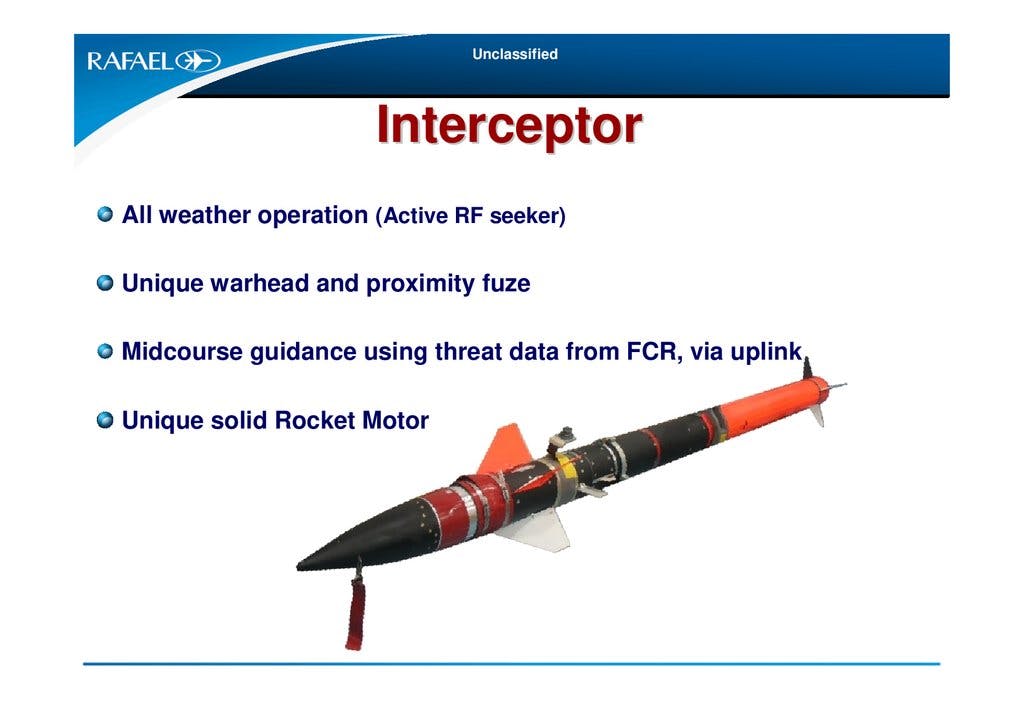
Figure: Tamir Missile
Source: The Drive.com
Each of the systems can carry up to 20 missiles and can deal with multiple targets simultaneously. It can also deal with precision-guided missiles.
Operational History:
The system became completely operational in 2011. Today, it is deployed in all Israeli air force bases to counter artillery barrage. The system was effectively used in the Gaza conflicts and Sinai insurgency. In 2012, CNN reported that the system has 85% success rate. The system has gone through continuous upgrades. During November 2018 Gaza clashes, the system hit 100 missiles fired from Gaza. In the same year, when revolutionary guards of Iran fired 20 missiles, it intercepted 4 where 16 missiles failed to reach Israeli territory. No casualties.
US funding:
The U.S. House of Representatives included report language in its FY-2013 Defense Authorization Act supporting Iron Dome with $680 million. There was a deal for joint production of this system to protect US bases from Taliban and then AQ threats. With the United States on track to greatly increase funding for Iron Dome, there had been calls for technology transfer and co-production of Iron Dome in the United States. In 2019, there was news that Israel refused to share its source code with US for security reasons and in fear that the Arab neighbors may buy the system in the future.
Future deployments:
Israel is planning to deploy Iron Dome batteries at sea, where they will protect off-shore gas platforms, working in conjunction with Israel’s Barak 8 missile system. The Israeli Navy’s future Sa’ar 6 missile ships will deploy two Iron Dome batteries on each ship.
It can be said that Israel has got the upper hand on its Arab neighbors for both defensive and offensive purposes. With the financial help of US and technological support from its domestic tech companies, it has developed a unique weapon and unveiled a new dimension of the defence sector. India, Azerbaijan, South Korea have shown a deep interest in this system. If we see it’s deployment along with Indo-Bangladesh border, we shouldn’t be astonished at all.

Figure: Sea-based Iron Dome
Source: Defence World.com