Now a days, technology becomes more and more popular in predicting anything. For example, if you think about Facebook, you can see that it continuously notices the friends that you connect with, the profiles that you visit very often, your interests, workplace, or a group that you share with someone, etc. Based on continuous learning, a list of Facebook users is suggested that you can become friends with. It is a real-life example of Machine Learning.
You can think another thing, which is when you upload a picture of you with a friend and Facebook instantly recognizes that friend. Facebook checks the poses and projections in the picture, notice the unique features, and then match them with the people in your friend list. The entire process is done with the help of Machine Learning. So, in this article, we will know about Machine Learning basics and its usefulness in our life.
What is Machine Learning?
Machine learning is the concept that a computer program can learn and adapt to new data without human interference. Basically, it is a type of Artificial Intelligence (AI) that allows software applications to become more accurate in predicting outcomes without being explicitly programmed. In deep meaning, Machine Learning is an approach to data analysis that involves building and adapting models, which allow programs to learn through experience.
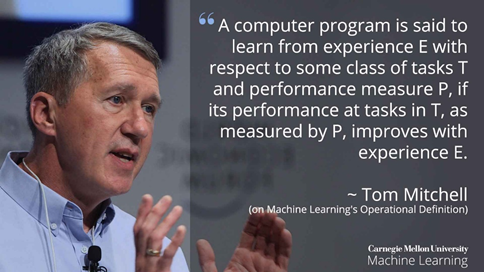
Fig: Definition of Machine Learning
Source: ml.cmu.edu
While considering this Machine Learning issue, many of us try to give a common example. That is the Cat vs Dog classification. For instance, we have a set of images of cats and dogs. What we want to do is classify them into a group of cats and dogs that means we have to separate cats on one side and dogs on another side. To do that we need to find out features of different animals such as: What is the height of each animal, How many eyes does each animal have, What is the eye color of each animal, What is the weight of each animal, etc.
After analyzing these features, we have to set up rules for classifying dogs and cats. Just example:
If height > 1 foot and weight >= 10 kg, then it could be a cat.
Here, what machine learning does is, process the data with different kinds of algorithms and tells us which feature is more important to determine whether it is a cat or a dog. So instead of applying many sets of rules, we can simplify this based on two or three features.
Here, what machine learning does is, process the data with different kinds of algorithms and tells us which feature is more important to determine whether it is a cat or a dog. So instead of applying many sets of rules, we can simplify this based on two or three features.
Machine learning models helps us in many tasks, such as:
- Object Recognition
- Prediction
- Classification
- Clustering
- Recommender systems etc.
Types of Machine Learning
Machine learning is divided into three types. They are:
- Supervised Learning
- Unsupervised Learning
- Reinforcement Learning
Supervised Learning:
Supervised learning is a branch of machine-related to inferring a function from labeled training data. We can roughly divide supervised learning into two categories: Classification and Regression. Classification involves categorical targets; such as image classification, to some advanced topics, such as machine translations and image caption. Regression involves continuous targets like stock prediction, image masking, etc. Supervised Learning is the one, where you can consider the learning is guided by a teacher. We have a dataset that acts as a teacher and its role is to train the model or the machine. Once the model gets trained it can start making a prediction or decision when new data is given to it.
Unsupervised Learning:
Unsupervised learning infers from unlabeled data, a function that describes hidden structures in data. In this type of algorithms, we do not have labeled data. So the machine has to process the input data and try to make conclusions about the output. In unsupervised learning, the model learns through observation and finds structures in the data. Once the model is given a dataset, it automatically finds patterns and relationships in the dataset by creating clusters in it. What it cannot do is add labels to the cluster, like it cannot say this a group of apples or mangoes, but it will separate all the apples from mangoes.
Reinforcement Learning:
Reinforcement learning is the training of machine learning models to make a sequence of decisions. Reinforcement learning means to learn from experience. The agent learns to achieve a goal in an uncertain, potentially complex environment. The agent is rewarded or penalized with a point for a correct or a wrong answer, and based on the positive reward points gained the model trains itself. And again once trained it gets ready to predict the new data presented to it.
Some Machine Learning Algorithms
1. Regression (Prediction)
We use regression algorithms for predicting continuous values. Regression algorithms are:
- Linear Regression
- Polynomial Regression
- Exponential Regression
- Logistic Regression
- Logarithmic Regression
2. Classification
We use classification algorithms for predicting a set of items’ class or category. Classification algorithms are:
- K-Nearest Neighbors
- Decision Trees
- Random Forest
- Support Vector Machine
- Naive Bayes
3. Clustering
We use clustering algorithms for summarization or to structure data. Clustering algorithms are:
- K-means
- DBSCAN
- Mean Shift
- Hierarchical
4. Dimensionality Reduction
We use dimensionality reduction for reducing the size of data to extract only useful features from a dataset.
5. Recommendation Systems
We use recommenders’ algorithms to build recommendation engines. Some examples are:
- Netflix recommendation system.
- A book recommendation system.
- A product recommendation system on Amazon.
Language (with libraries) for Practicing Machine Learning
Python is a popular and general-purpose programming language. We can write machine learning algorithms using Python. The reason why Python is so popular among data scientists is that Python has a diverse variety of modules and libraries already implemented that make our life more comfortable.
Some best Python libraries are:
- Numpy: It is a math library to work with n-dimensional arrays in Python. It enables us to do computations effectively and efficiently.
- Scipy: It is a collection of numerical algorithms and domain-specific tool-box, including signal processing, optimization, statistics, and much more. Scipy is a functional library for scientific and high-performance computations.
- Matplotlib: It is a trendy plotting package that provides 2D plotting as well as 3D plotting.
- Scikit-learn: It is a free machine learning library for python programming language. It has most of the classification, regression, and clustering algorithms, and works with Python numerical libraries such as Numpy, Scipy.
So, here I tried to give a basic idea on Machine Learning with real-life examples, its categories, different algorithms, and some libraries which are vastly used in Python for Machine Learning. I Hope, all of you will find this as an interesting one.